
Vehicle tax (VED) can be a confusing topic, especially for future campervan owners. In this guide, we’ve broken down everything you need to know, and how much you can expect to pay. Read on to find out.
In the campervan or motorhome buying process, one of the biggest annual costs to consider is your road tax (now called Vehicle Excise Duty or VED). For vehicles registered before 2020, getting the VED costs for your campervan or motorhome can be confusing and stressful.
For those not buying new registrations, road tax, or VED, is still a confusing topic as it largely depends on a number of factors.
As both campervan owners and specialist insurers of all campervans since 1998, we’ve gone through this process so many times, and wanted to help others through the same process, as we know how confusing it can be.
Don’t forget to insure your vehicle with the protection it deserves and enjoy complete peace of mind. Explore our handy guide for all you need to know about motorhome insurance.
Is it Road Tax or VED?
First things first, a clarification. VED (Vehicle Excise Duty) is the official name for road tax. VED is also called vehicle tax or car tax, and the government has now taken to using vehicle tax to make it as simple as possible to understand, as it’s a tax on owning a vehicle, not on using the roads.

What is Vehicle Tax (VED) for Campervans and Motorhomes and How is it Calculated?
In the eyes of the DVLA (Driver and Vehicle Licensing Agency), campervans and motorhomes are the same thing, so they don’t differentiate.
The amount of vehicle tax you pay on your campervan depends on its weight, and the date it was registered, and these factors determine how the tax is calculated.
Campervans/Motorhomes Over 40 Years Old
If your campervan was built or registered over 40 years ago, then you don’t have to pay vehicle tax. You have to register as if you were going to pay tax, but you won’t be charged as long as you apply for a tax exemption.
The calculation is done from April every year, so in 2023, vehicles built or registered before 1st January 1982 could apply for a tax exemption from 1st April 2023.
Campervans Registered Before 1st March 2001
For campervans less than 40 years old, but registered before 1st March 2001, it depends on your gross (also called maximum or revenue) vehicle weight and engine. Campervans weighing under 3,500kg were classed as a light goods vehicle, and so were taxed as such.
If your campervan weighs under 3,500kg and has an engine size under 1549cc, then you will be charged £180 per year, and if the engine size is over 1549cc, then you will be charged £295 a year.
Those weighing over 3,500kg will have to check with the manufacturer, as the government doesn’t currently provide information on this.

Campervans Registered from 1st March 2001 to 1st April 2017
If your campervan weighs under 3,500kg and has an engine size of under 1549cc, then you will be charged £180 per year, and if the engine size is over 1549cc, then you will be charged £295 a year.
If it’s over 3,500kg, you’ll pay £165 annually.
What about Euro 4 and Euro 5 Compliant Campervans?
If your campervan is Euro 4 compliant and registered between 1st March 2003 and 31st December 2006 or Euro 5 compliant and registered between 1st January 2009 and 31st December 2010, then you will pay £140 annually.
Campervans Registered Between 1st April 2017 and 11th March 2020
Now, this is where it gets confusing.
If your motorhome or campervan was registered between 1st April 2017 and 11th March 2020, it is in the M1SP (Special Purpose) category (check with your manufacturer or dealer if unsure), and has its CO2 emissions included on the type approval certificate, then you will pay a different rate. Confusing right?
If all of the above apply, you’ll pay as if you were a car, hence why you need the emissions certificate.
Get a quick online quote and insure your campervan or motorhome today!
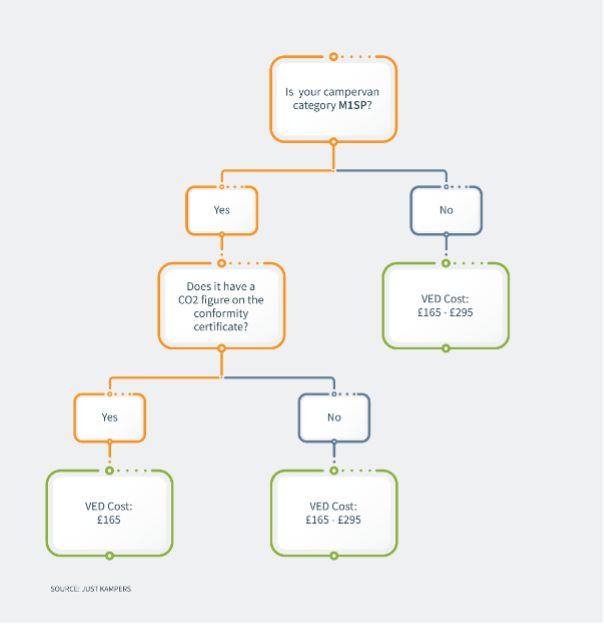
So, if you have a campervan that meets the above criteria, then you will pay the second payment of £165 annually, or if your list price was above £40,000 then you’ll pay £520 annually for the first five years, starting from the second year you pay tax. After that, it will go down to the second tax payment cost.
Otherwise, you pay the standard motorhome charge, of either £180, £295 or £165.
Campervans Registered After 11th March 2020
Now, it’s much simpler.
It follows the standard motorhome charge scheme, which is as follows:
Under 3,500kg gross vehicle weight
| Engine Size (cc) | Single 12-month payment |
| Not over 1549 | £180 |
| Over 1549 | £295 |
Over 3,500kg gross vehicle weight campervans pay an annual cost of £165.
Why Do Some M1SP Motorhomes Pay a Different VED?
This was all to do with a change in how new motorhomes were classified at registration. The laws at the time were changed to state that for the purpose of VED, motorhomes and campervans should fall into category M1SP (Special Purpose). This meant that the manufacturer(s) had to provide a Certificate of Conformity (COC) at each stage of the manufacturing process.
For cars, this was simple as they are all built by the same people in the same process.
However, for campervan and motorhome manufacturers, this is trickier, as they are manufactured at different stages by different people. The chassis may be done in one place, the exterior built at another, and final interior changes completed elsewhere. This meant that the Certificate of Conformity (COC) provided to the DVLA often had no CO2 figures on, as only the last manufacturer’s COC was considered for the purposes of VED.
So, if the last manufacturer’s COC had no emissions data on, the motorhome was classified as a motorhome, and taxed using the private light (or heavy) goods vehicle cost. For those that had a CO2 figure on their emissions certificate, they were charged the first-year car cost, which could be up to £2,135.
This came into force for September 2019 due to EU law changing, but only lasted a short six and a half months thanks to lobbying from the National Caravan Council. Any new motorhomes or campervans registered between 1st September 2019 and 11th March 2020 did have to pay the increased first year tax costs. Motorhomes/campervans registered after March 2020 now pay the ‘van’ rate, which is what it was previously.
As shown above, campervans that meet the M1SP criteria and have an emissions certificate now pay the second-year cost for cars, but any other campervans/motorhomes won’t.

A Quick Summary: What do I Need to Remember?
In summary, the amount of vehicle tax you’ll pay on your campervan or motorhome depends on:
- When it was first registered,
- The vehicle’s weight,
- Engine size,
- Emissions
Vehicles over 40 years old can often be exempt from vehicle tax. More modern ones can fall into one of several different categories, so it’s important to check which class applies to your vehicle, to avoid paying the wrong amount.
Insure your vehicle with Just Kampers Insurance and get an Exclusive Discount on parts and accessories at Just Kampers!
Is road tax cheaper for a campervan?
Road tax for campervans and motorhomes is the same, so neither is cheaper than the other. And, as some campervans are taxed as cars, the cost is largely the same.
Do you pay road tax on a campervan?
Yes, you do pay road tax on campervans and motorhomes, although they are classified as light goods vehicles rather than cars. They will either be class TC11 (Private or Light Goods) or class TC10 (Private Heavy Goods).
Don’t Forget Insurance When You Tax Your Vehicle
Just Kampers Insurance provides specialist campervan insurance for campervan owners, by campervan owners.
We remain competitive, and if we can’t beat your quote, we’ll give you a £50 Just Kampers gift card. Why not see how we can help you today?
In this article
- Is it Road Tax or VED?
- What is Vehicle Tax (VED) for Campervans and Motorhomes and How is it Calculated?
- Campervans/Motorhomes Over 40 Years Old
- Campervans Registered Before 1st March 2001
- Campervans Registered from 1st March 2001 to 1st April 2017
- What about Euro 4 and Euro 5 Compliant Campervans?
- Campervans Registered Between 1st April 2017 and 11th March 2020
- Campervans Registered After 11th March 2020
- Why Do Some M1SP Motorhomes Pay a Different VED?
- A Quick Summary: What do I Need to Remember?
- Don’t Forget Insurance When You Tax Your Vehicle